
Where Faith Meets Politics: KCL Students Join APPG Discussion
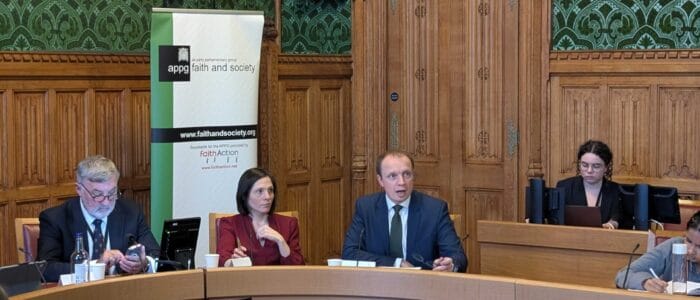
On Wednesday 11th February, FaithAction had the pleasure of taking a group of King’s College London (KCL) students to the House of Lords. The students were part of the university’s Sociology, Politics and Religion degree – a course designed to teach individuals the complexities of faith, politics and society. The students were able to engage with members of the APPG on Faith and Society about the nature of politics and religion, reflecting on their role as parliamentarians and how faith shapes politics and vice versa.
The members of the APPG on Faith and Society who joined us included Sarah Smith MP, Darren Paffey MP, Lord Rees of Eaton and Lord Alderdice.
The meeting was opened by Dr Daniel DeHanas, course leader, who explained that the course itself was designed to have a wholistic approach in understanding politics and society, equipping the students with the knowledge to pursue careers in Public Service, Diplomacy and the Civil Service.
Darren Paffey MP spoke about the influence of faith within his political decision-making. He stated that, “…its certainly deeply present in how I think about the social problems that we come to face as parliamentarians…faith is very much a common force of good.” The other politicians echoed a similar sentiment; Faith existing as a galvanising force of good, a pillar within society that has the organisational capacity to shape communities.
For Sarah Smith MP, faith is central to her politics, she stated that her roots were situated heavily in faith because the Labour Party itself was founded by a preacher who valued faith as much as he valued the representation of the working man; “I look at Keir Hardie, who founded our party, he was a preacher, he went out and preached the values of the Labour party…you must never forget the roots of where our party came from.”
Lord Alderdice touched on how important faith is because it has historically prioritised community, and reflected on how this manifested in a negative way during his involvement in politics in Northern Ireland; “but not least because we discovered that the real problem wasn’t structures or policies…but the fundamental problem was [the] distorted historical relationship between communities…” In the context of Northern Ireland, the breakdown of communication within the wider communities, developed into a crisis. He noted, however, that faith organisations have an in-built public messaging infrastructure, meaning when a crisis arrives within the community, faith organisations have the “communal” tools to deal with it, and within Northern Ireland in particular, this led to faith representatives being the key points of connection between paramilitary organisations and the government and helped achieve peace.
Lord Rees spoke about how Christianity gave him personhood, citing the gospel of John as his deepest inspiration, providing him with the values which shaped his character, as he wrestled with his thoughts about his own identity. He also reflected upon his time as Mayor of Bristol and the role of faith settings for providing practical support for communities. “If you [a faith leader] turn up and ask what I’m doing about poverty – I will ask what are you doing?”
The students were pleased to take part in the Q&A session that followed, and asked the parliamentarians a range of questions including how much faith should interact with policymaking, whether it was important that a broad spectrum of faiths had opportunity to input into systems and policy, and how places of worship can support their local communities.
The answers provided led to discussion about how their faith influenced their decision making when it came to issues such as abortion and assisted dying, which have both been points of debate during the current parliament, while also juggling their responsibility as a representative of their constituency and inputting the views of their constituents into these debates. The parliamentarians also mentioned that they had to bring many different lenses to their work, only one of which was their faith and that there often had to be a wrestling with these different viewpoints.
FaithAction and the APPG on Faith and Society would like to thank the members of the APPG who joined us to share their views, and the students from King’s College London for their insightful and interesting questions.