
Reflections on Faith-Based Communities, Equity and Mental Health: Bridging Research and Policy
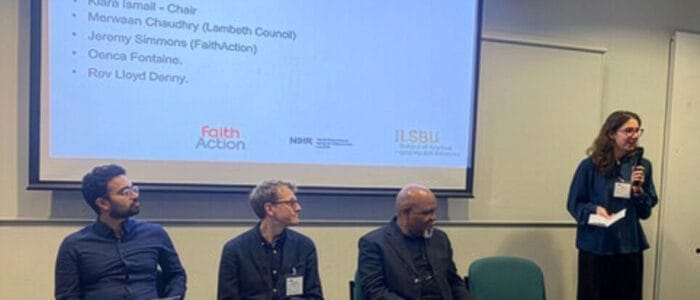
On Thursday 13th November, Faith Action co-delivered an event titled “Faith-Based Communities, Equity and Mental Health: Bridging Research and Policy” led by Dr. Ope Atanda, a lecturer in Psychology and researcher at London Southbank University. We were pleased to welcome about 30 audience members to the event, including representation from faith and community leaders, local government members, public health, and wider public services.
Dr. Atanda showcased his original and timely 12-month research project to develop faith-based mental health interventions for Black majority communities, alongside presenting a policy brief which reviewed evidence, and proposed actionable recommendations for policy change around faith and mental health. The original research focused on Christian faith, but there is exciting scope to expand the work into a multifaith strategy to benefit those of all faiths.
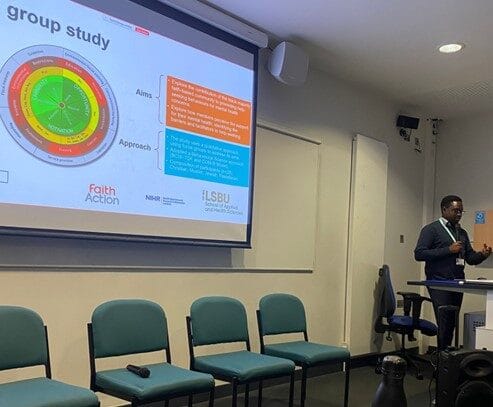
The evening kicked off with an inspiring keynote address by Cllr. Evelyn Akoto, the Cabinet Member for Health & Wellbeing at Southwark Council. As a woman of faith herself, she was passionate about how local authorities working with faith groups is essential to building a strong community spirit.
“Faith communities often see the need long before the help comes but might not be equipped to deal with it … they’re really first responders without the title.”
Dr. Atanda then introduced his research methodology and findings. He cited the COM-B framework for behaviour change which he used to measure how confident participants felt seeking mental health support. COM-B stands for:
- (C) Capacity: Do I have the knowledge and skills to do this thing?
- (O) Opportunity: Do I have the time and resources? Is it what others do around here?
- (M) Motivation: Do I believe it is a good idea? Do I want to make it a habit?
Capacity, Opportunity, and Motivation are the three essential components of influencing Behaviour (B).
Dr. Atanda found that since few conversations around mental health were happening in Black majority churches, congregants were rated low in all three behavioural components. For example, he found low mental health literacy, with supernatural connotations around poor mental health like witchcraft, or a punishment from God. There was also an overreliance on prayer, which, while powerful and healing in its own right, at times delayed necessary professional care.
In order to try to change this, Dr. Atanda worked with several faith and community leaders to co-produce a faith-based intervention which would aim to improve health literacy, reduce stigma and widen access to services. This intervention includes training for faith leaders to deliver sessions on mental health within the faith space and promote referral pathways and signpost struggling or vulnerable congregants to relevant mental health support services. It also encompasses peer-led faith support groups and the development of a faith-inclusive mental health resource, to be produced in both print and digital format.
One of the faith leaders involved, Pastor Franklin Akpomuvwe, shared his experience while partaking in the project:
“Far beyond your scope as a faith leader you need to be able to signpost your congregants effectively. If [the faith leader] is unaware, his scope is not broadened, and the congregant continues to suffer.”
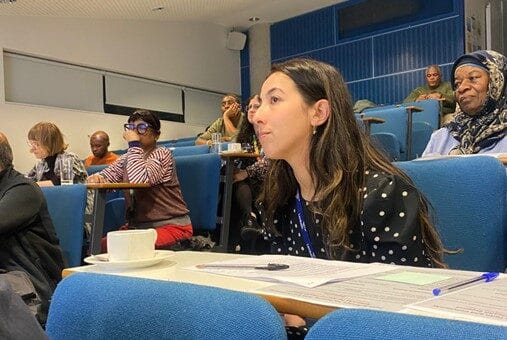
The second half of the event emphasised dialogue, co-production and iterative feedback between researcher and audience. In preparation, FaithAction had supported Dr. Atanda in developing his research findings into a policy brief to make government recommendations and encourage actionable change. This brief was presented to all audience members to make notes on and provide feedback.
After an equally inspiring second keynote address by Rev. Lloyd Denny, senior minister, General Secretary of Restoration Revival Fellowship and Luton Community Champion, we held a panel discussion.
The panel featured Merwaan Chaudhry (Lambeth Council), Jeremy Simmons (Policy and Programme Manager at FaithAction), Oenca Fointaine (Founder of The Online Leadership Academy CIC) and Rev. Lloyd Denny (senior minister and Luton Community Champion). The panel was chaired by Klara Ismail, Policy and Engagement Officer for FaithAction.
A snippet of what we discussed includes:
- “How do faith and culture shape mental health experiences within Black communities, and what are the main gaps in current policy responses?”
- “What can local authorities, Integrated Care Boards (ICBs), and policymakers learn from faith-based and community-led approaches to tackling mental health inequalities?”
- “How can we build sustainable partnerships between faith organisations, public health teams, and universities to support culturally grounded interventions?”
We’re very proud of this unique interactive event featuring Dr. Atanda’s research methods and findings, two inspiring keynote speakers, an engaging panel chaired by FaithAction and some audience questions at the end.
We will continue to promote this work and champion better integration of faith-based approaches within public health. We will be working with Dr. Atanda to identify potential opportunities to pilot the co-produced intervention, and evaluate its effectiveness to strengthen the evidence base.
A revised policy brief will be published, integrating the findings from the discussions within the event. We encourage you to look out for this brief in due course.
Please get in touch with us if you’d like to know more about this work, or if you have any reflections of your own about this important area. We’d love to keep you informed.