Creative English for Preconception and Infant Health in Birmingham
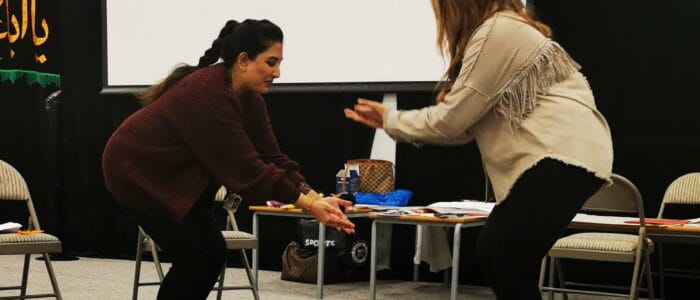
As hubs complete their final sessions and we gather up the last of the end-of-project questionnaires, we are looking back over the last year and celebrating the impact of Creative English for Infant Health in Birmingham.
Creative English is an innovative, co-designed and evidenced-based approach to learning English, which uses applied drama techniques to build participants’ confidence and understanding to navigate systems and services. At the same time, it accelerates the development of friendships and networks of peer support. Health focussed variations of the programme target participants’ heath literacy related to specific conditions and provide a safe space to explore how best to put this learning into practise.
Following successful programmes addressing health inequalities related to child respiratory health and cardiovascular disease, Public Health Birmingham funded the programme 2025-6 to address inequalities in health outcomes for infants. The city has a high rate of infant mortality, due to a significant level of deprivation in the city, with an infant mortality rate of 7.0 (deaths per 1,000 live birth) compared to 3.9 for England and 5.6 for the West Midlands (2017-2019) and is working hard to reduce this as a priority in the Birmingham and Solihull Integrated Care System’s Strategy for Health and Care 2023-2033 and Joint Health and Wellbeing Strategy ‘Creating a Bolder, Healthier City 2022- 2030′ – an agenda Creative English is able to support, as language is a key social determinant of health outcomes.
Preconception health
Improving pre-conception health and engagement with health services have been key goals of the Creative English for Infant Health programme. Confidence to attend a thalassaemia or sickle cell screening, for example, increased from 11.1% to 81.4% in pre and post course surveys. “This give me confidence to talk to my GP and what to say at appointment.”
Participants reported a wide range of impacts primarily around being better prepared for pregnancy, such as Farhana:
“I didn’t know you had to look after yourself before you have a baby – what to eat, weight management, exercise, how to talk to doctor, to midwife, how go to dentist. I have learned so much and go to GP in UK for first time because [of] this class. I lose weight before [I was] pregnant with [my] baby. I walk round park every day. I eat healthy food, take folic acid, get vaccine. I never do this before this class. Now I [am] pregnant. My baby is happy.”
Taking action
The session methodology encourages people to take action to improve their health. By the end of the programme, for example, 94.3% of participants were doing the recommended 150 mins of exercise per week. This is an increase from 37% at the start. The social aspect of the programme encouraging friendships, combined with delivery in community spaces where other activities are available helps this to happen. As one participant explained, “I think it’s because this centre also have exercise [class] and we [become] friends and say ‘we go together. Other ladies go for walk in park – this class helps [people to become] friends and friends help exercise. Your friend is going. You go!”
Increasing knowledge in the wider community
An exciting outcome of being able to run the infant health programme over a full 12 months has been the fact that there has been clear opportunity to demonstrate the impact on the wider community. For the 3 hubs involved in the pilot, where the programme was delivered once over a 10-week period baseline knowledge was low. Only 17% of participants, for example, knew about the importance of taking folic acid and vitamin D in pregnancy before the programme, and even in general terms only 35% knew what was considered a healthy diet.
Much to the frustration of some of our volunteers who want the impact from the sessions captured, we have found an increase in awareness both in hubs that have delivered the programme in the pilot, but also in knowledge demonstrated by participants between cycles of the programme across the year, as participants share knowledge with one another in the faith or community centre the programme is delivered in. 38% of participants reported knowing about folic acid and 61% said they knew about healthy diets at the start. These figures increased to 93.5% and 98.4% respectively at the end of the programme. Facilitators reported that this was not information they would have known prior to talking to other people who had already attended. As one facilitator explained:
“You just hear the women telling one another. I learned this and I learned that. And you think that’s learning they’ve only got because of the programme, but it’s not going to show up on the surveys they’ve done. But I suppose it shows how useful the information is – that they want to share it”
This is reflected in the survey data when more recent cohorts are much more likely to be aware of key messages at the start of the programme than those attending the initial courses. Despite facilitators finding this frustrating, this is actually an excellent outcome of the programme. Many participants across the different locations have chosen to get involved with the delivery of the programme, supporting with interpretation and cultural adaptations, raising awareness across the groups
Wider benefits – not just limited to the specific health focus of sessions.
The benefits of the infant health version of the programme aren’t just restricted to infant health. Examples included Robina came to England from Spain a few years ago and was not confident in her English. She joined the Creative English for Health course. Her mother-in-law is a long-term heart patient who was often cared for by family members. Usually, if her mother-in-law experienced any complications, a male family member or someone fluent in English would call emergency services for an ambulance. However, when Robina was alone with her mother-in-law, she experienced severe difficulty in breathing. With no one around to help, Robina used the skills she had learned in the course to call an ambulance, answer their questions, and effectively save her mother-in-law’s life. Her family was extremely proud of her for her confidence in both her English and her knowledge from the course. She said she was very grateful for the course for teaching her how to save one of her family members’ lives.
Are you a commissioner or working within a public health team? Find out how you could address targeted health needs in your community here Commission a Creative English course — Creative English or, if you represent a faith or community group, buy a licence to deliver our general Creative English for Health in your community.