
APPG on Faith and Society: Highlights from Faith and Social Care Roundtable
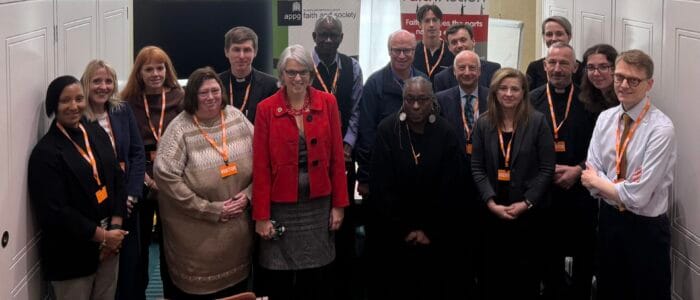
On 15th October, the All-Party Parliamentary Group (APPG) on Faith and Society hosted their Faith and Social Care Roundtable: Experience, Practice and Partnership. Social care is a new stream of work for the APPG, and we expect this event to be the first of several exploring how faith-informed social care practices can be beneficial at both an individual and community level to turn policy into practice.
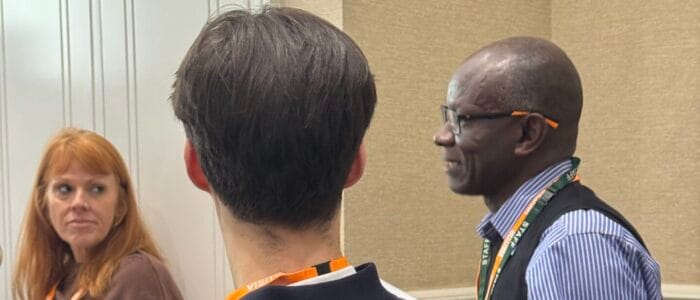
Anna Dixon MP, Officer of the APPG and Labour MP for Shipley, chaired the event, which welcomed faith and social care organisations who all shared experiences in providing faith-informed social care, whether through organisational or informal care and support. The roundtable discussion was also joined by Sarah Coskeran, representative of the Casey Independent Commission on Adult Social Care, and Will Hatton, Strategic Analysis Lead on Adult Social Care at the Department of Health and Social Care (DHSC).
The discussion was positive, encouraging and collaborative. The conversation focused on how vital spiritual well-being is when providing an individual with care, alongside physical, social and emotional well-being.
Spiritual well-being, as well as social and emotional well-being, should be a part of what is care and support
Anna Dixon MP
You can’t deliver care without knowing what’s really important to that individual. And you can’t ignore faith as part of that
Jazz Browne, Nubian Life
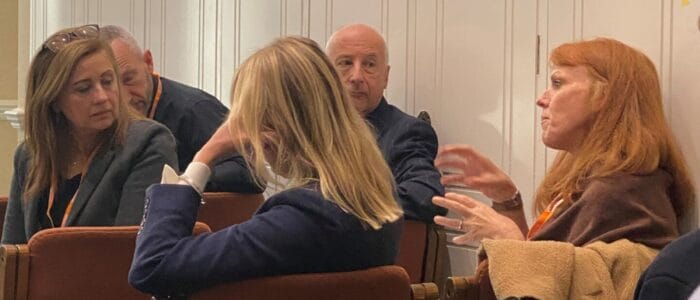
Many participants shared the vital work they were engaged in to provide care for their communities. More social care service providers across the board are including chaplaincy services as part of their care delivery and have noticed an increase in individuals taking up the option of chaplaincy, including from individuals of no faith, highlighting the benefits of spiritual care for everyone.
Faith organisation representatives also highlighted the valuable informal care they were providing for their communities, such as safe sensory spaces for people with autism and learning difficulties, memory cafes for the elderly and those living with dementia, operating food and hygiene banks, and more.
Local faith based organisations, local churches, mosques and temples, are doing a huge amount in terms of social action supporting elderly and disabled people to live well in the community
Anna Dixon MP
Faith organisations provide a host of care and support but no one thinks of that as care … someone’s faith community is often their first point of call
Daniel Singleton, FaithAction
The statutory service is big. But the voluntary service is way bigger
Nick Mottershead, Holy Sepulchre Church
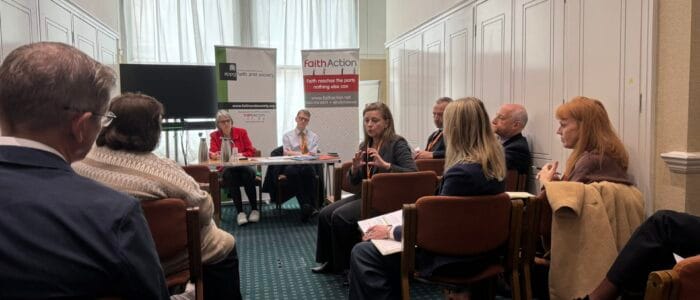
On the topic of informal care, participants were keen to stress that the community support provided by faith organisations should not be overlooked or taken for granted.
There is a presumption that, somehow, FBOs will just keep providing informal care for their communities. This is a misnomer. They do need the support and resources
Sam Monaghan, Methodist Homes
You try to meet the need of all individuals but there’s simply not enough support and resources. Everyone is thinly stretched. Statutory services just don’t get it
Jazz Browne, Nubian Life
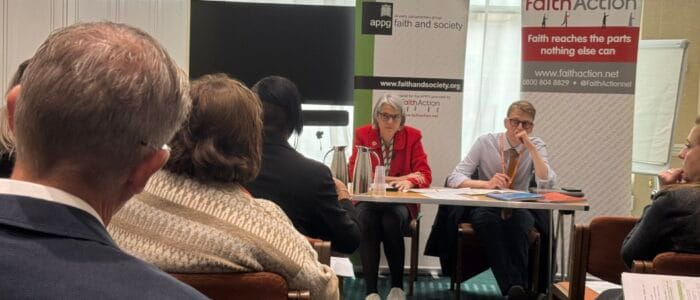
Towards the end of the discussion, focus moved to envisioning how collaboration between statutory services and voluntary services can help strengthen faith-informed care services.
The Faith Covenant has formed a relational bridge which could take other weight
Daniel Singleton, FaithAction
Despite a largely secular culture, there is still a great deal of suspicion about engaging with faith organisation … we are, together, part of the solution
Rev Dr Paul Goodliff, Anna Chaplaincy
Please get in touch with us if you’d like to know more about this work, or if you have any reflections of your own about this important area. We’d love to keep you informed.