Resources about Evidence and case studies

Browse the variety of publications, research and toolkits we've produced so far.

Ten Years of the Faith Covenant

The purpose of the evaluation is to independently assess how the Covenant has operated in practice since its introduction and to evaluate the difference it has made to collaboration between faith communities and public bodies, grounded in the understanding that effective collaboration better serves their communities. In doing so, the research seeks to provide a clearer understanding of the Covenant’s contribution to partnership working and to identify lessons that can inform its future development. The evaluation was designed around the following key aims and objectives: Document and analyse implementation approaches, examining how the Covenant has been adopted and implemented across different
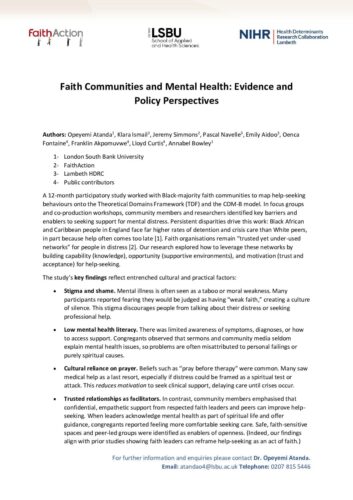
Faith Communities and Mental Health: Evidence and Policy Perspectives

This policy brief is the culmination of a 2‑month research project to develop faith-based mental health interventions for Black majority communities, which was co-produced, led by Dr. Ope Atanda, a lecturer in Psychology and researcher at London Southbank University. His research focuses on Christian faith, but there is exciting scope to expand the work into a multifaith strategy to benefit those of all faiths.

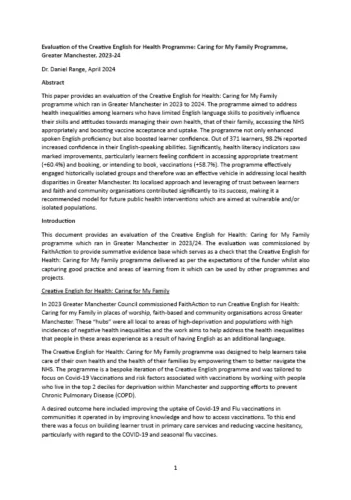
Creative English for Health Manchester Evaluation 2024

This paper provides an evaluation of the Creative English for Health: Caring for My Family programme which ran in Greater Manchester in 2023 to 2024. The programme aimed to address health inequalities among learners who have limited English language skills to positively influence their skills and attitudes towards managing their own health, that of their family, accessing the NHS appropriately and boosting vaccine acceptance and uptake. The programme not only enhanced spoken English proficiency but also boosted learner confidence. Out of 371 learners, 98.2% reported increased confidence in their English-speaking abilities. Significantly, health literacy indicators saw marked improvements, particularly learners

Café Connect Evaluation

This document provides an evaluation of the Café Connect programme and was commissioned by FaithAction with a dual remit. The first is a traditional summative evaluation which serves as a check that the Café Connect project has delivered as per the expectations of the funder. The second aspect of the remit builds an understanding of the externalities of the Café Connect work around the impact of it on cohesion, particularly between recently arrived migrant groups and the local “host community”. This includes an exploration of cohesion and intergroup contact in relation to themes around belonging, group identity and prejudice-related attitudes towards difference and

Inclusive Social Prescribing

What did we do? Through focus groups and interviews with both health system partners and VCFSE representatives, our goal was to find out: What does “inclusive social prescribing” mean? What challenges do we face in making this a reality? What actions are needed:  From VCFSE organisations? From statutory health partners? What did people say “inclusive social prescribing” looks like? Something everyone is aware of and can fully understand Accessible to all, especially for those who struggle to access primary care Focussed on the whole-person, and what and who matters to them Involves communities from the start, and throughout What were the key challenges

Tower Hamlets Faith Health Action Partnership evaluation

This report provides an evaluation of FaithAction’s Tower Hamlets Faith Health Action Partnership (FHAP) project. The first focus on the evaluation is to provide a summative assessment which looks at the extent to which the FHAP project has delivered as per the expectations of the funder. To this end, the evaluation approach has looked to capture good practice and areas of learning from FHAP which can be used by other programmes and projects. The second focus is on trust: the evaluation aims to build an understanding of the relationship between FHAP’s approach and activities and the trust

Right Up Your Street

How faith-based organisations are tackling loneliness. This report aims to explore the wide-ranging work of faith groups in response to the problem of loneliness. As a national network of faith-based organisations we are well aware, through contact with our members, that much is being done on the ground, but we wanted to probe further: To what degree is loneliness a priority for faith groups? What specifically is being done to address it? What themes and good practice can be identified that might be taken forward?

Dementia Friendly Communities

Dementia is an umbrella term that describes the symptoms that occur when the brain is affected by certain diseases or conditions – for example, Alzheimer’s disease or a series of strokes. Symptoms may include memory loss and difficulties with thinking, problem-solving or language. There are 850,000 people living with dementia in the UK – a number expected to rise to over a million by 2025. Already an estimated 21 million people in England have a close friend or family member living with dementia. And, according to Alzheimer’s Research UK, dementia is the most feared health condition for people over the age of 55.

Keeping Pressure Off Hospitals

FaithAction was asked by Jon Rouse, then Director General in the Department of Health (now Chief Officer of the Greater Manchester Health and Social Care Partnership), to comment on the role that faith-based organisations (FBOs) currently play in providing out-of-hospital care in England – and what role they could play in the future. To help answer this question, FaithAction: Held three roundtable discussions, in Leeds, Greater Manchester and Hertfordshire. These gave FBOs the opportunity to highlight their work in this area, and also to meet with health commissioners and hear about local priorities for health and care. Used an online survey,

Friendly Places Impact Assessment

Our impact assessment focused on whether those who had signed the Friendly Places pledge or taken part in the training had taken action to make their organisation more mental health-friendly. We did this through: An open invitation, through our e‑news, for organisations to feed back with any action they had taken since signing the pledge or taking part in training Direct contact with those who had taken part in the training in 2014–15 to see if they had taken action Asking workshop participants what action they planned to take as a result of the session, ‘tomorrow’, ‘next week’ and ‘within the

Share this via