Ten Years of the Faith Covenant

The purpose of the evaluation is to independently assess how the Covenant has operated in practice since its introduction and to evaluate the difference it has made to collaboration between faith communities and public bodies, grounded in the understanding that effective collaboration better serves their communities.

In doing so, the research seeks to provide a clearer understanding of the Covenant’s contribution to partnership working and to identify lessons that can inform its future development.

The evaluation was designed around the following key aims and objectives:

  • Document and analyse implementation approaches, examining how the Covenant has been adopted and implemented across different local contexts since signing.
  • Assess impact on policy and practice, including the ways in which the Covenant has influenced collaboration, governance and partnership working between faith communities and statutory bodies.
  • Identify limitations and areas for improvement, drawing on evidence from stakeholders involved in Covenant activity.
  • Synthesize findings for wider application, identifying lessons that may inform policy and practice across the public sector.

Alongside these objectives, the evaluation was also designed to capture practical learning from Covenant areas in order to better understand how the framework operates in practice. In addition to assessing the Covenant’s impact to date, the research therefore sought to document the experience of those directly involved in its development and delivery, with a view to identifying insights that may inform future implementation.

This work forms part of a wider research initiative supported by the Sir Halley Stewart Trust examining ten years of the Faith Covenant and its contribution to collaboration between statutory bodies and faith communities in the UK. The project aims to strengthen the evidence base surrounding the Covenant and to capture learning from its implementation across different local contexts, helping to inform future policy discussions and cross-sector partnership working involving faith communities.

To learn more about implementing the Faith Covenant, see our Faith Covenant Guidebook.
Ten Years of the Faith Covenant

An independent evaluation by the Centre for Inclusive Evaluation and Coventry University.

Share this via

More resources

The Faith Covenant Guidebook

The Faith Covenant Guidebook forms part of a wider two‑part project, funded by the Sir Halley Stewart Trust, looking to better understand and strengthen Faith Covenants. Part one of the project included an independent mixed-methods evaluation of the Faith Covenant, led by Coventry University and the Centre for Inclusive Evaluation, and part two will involve building upon that learning through guidance and practical workshops. The evaluation of the first ten years of the Faith Covenant, released earlier this year, is available to read here. Whilst the Faith Covenant has been around for over a decade, it had never been formally evaluated, so

Talking faith in suicide prevention

This resource is a primer to support faith-informed conversations about suicide prevention and postvention with members of the public, designed to support general prevention conversations, rather than crisis presentations. It is meant to support front-line workers, people leading front-line teams, and anyone planning or implementing suicide prevention or postvention strategies in public or voluntary, community and faith sectors (VCFSE). It was developed in collaboration with representatives of six faith traditions, as well as front-line workers and people with lived experience, via a series of one-to-one interviews, one listening workshop, one larger design workshop, and editing contributions from an expert panel throughout

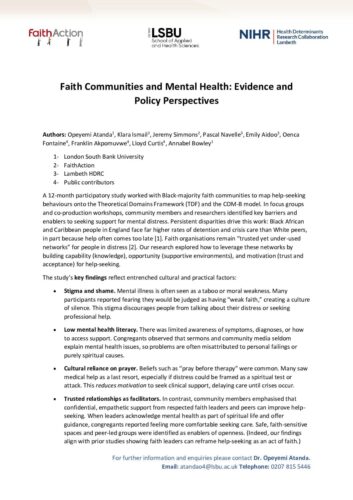
Faith Communities and Mental Health: Evidence and Policy Perspectives

This policy brief is the culmination of a 2‑month research project to develop faith-based mental health interventions for Black majority communities, which was co-produced, led by Dr. Ope Atanda, a lecturer in Psychology and researcher at London Southbank University. His research focuses on Christian faith, but there is exciting scope to expand the work into a multifaith strategy to benefit those of all faiths.

Faith — Too Significant To Ignore

We have summarised our desires in this manifesto as a desire for decency. We want to see a government that promotes decency for the communities of the United Kingdom, as well as seeking to promote this decent life to both our next-door and global neighbours. “What is decent?” is a question that can be asked of policy far beyond that which is covered in the specific ideas contained in these pages. The question of how we promote decency in terms of quality of life and conduct of ourselves and others can be a guiding principle for the Ministry of Defence as much as it