Talking faith in suicide prevention

This resource is a primer to support faith-informed conversations about suicide prevention and postvention with members of the public, designed to support general prevention conversations, rather than crisis presentations. It is meant to support front-line workers, people leading front-line teams, and anyone planning or implementing suicide prevention or postvention strategies in public or voluntary, community and faith sectors (VCFSE).

It was developed in collaboration with representatives of six faith traditions, as well as front-line workers and people with lived experience, via a series of one-to-one interviews, one listening workshop, one larger design workshop, and editing contributions from an expert panel throughout Summer–Autumn 2023.

This work has been supported by the Royal Borough of Kensington and Chelsea and Westminster City Council as part of a wider project looking at suicide prevention and faith and belief. This work was made possible through funding from the VCSE Health and Wellbeing Alliance, jointly managed by the Department of Health and Social Care, NHS England, and the UK Health Security Agency (UKHSA).

Talking faith in suicide prevention

This online resource is a primer to support faith-informed conversations about suicide prevention and postvention with members of the public.

Share this via

More resources

The Faith Covenant Guidebook

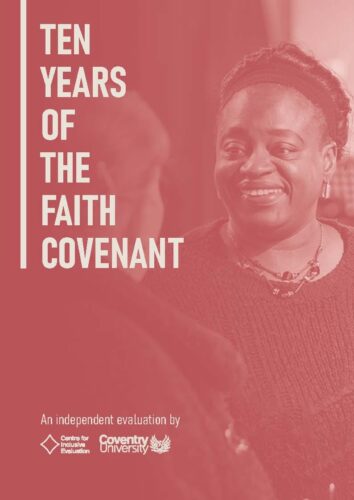
The Faith Covenant Guidebook forms part of a wider two‑part project, funded by the Sir Halley Stewart Trust, looking to better understand and strengthen Faith Covenants. Part one of the project included an independent mixed-methods evaluation of the Faith Covenant, led by Coventry University and the Centre for Inclusive Evaluation, and part two will involve building upon that learning through guidance and practical workshops. The evaluation of the first ten years of the Faith Covenant, released earlier this year, is available to read here. Whilst the Faith Covenant has been around for over a decade, it had never been formally evaluated, so

Ten Years of the Faith Covenant

The purpose of the evaluation is to independently assess how the Covenant has operated in practice since its introduction and to evaluate the difference it has made to collaboration between faith communities and public bodies, grounded in the understanding that effective collaboration better serves their communities. In doing so, the research seeks to provide a clearer understanding of the Covenant’s contribution to partnership working and to identify lessons that can inform its future development. The evaluation was designed around the following key aims and objectives: Document and analyse implementation approaches, examining how the Covenant has been adopted and implemented across different

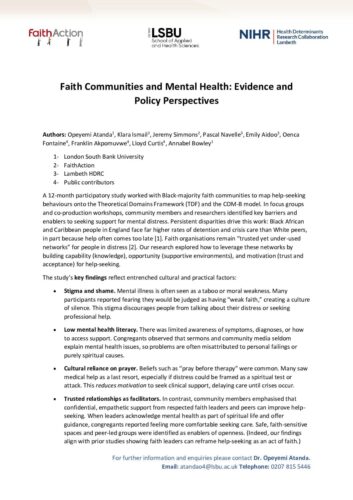
Faith Communities and Mental Health: Evidence and Policy Perspectives

This policy brief is the culmination of a 2‑month research project to develop faith-based mental health interventions for Black majority communities, which was co-produced, led by Dr. Ope Atanda, a lecturer in Psychology and researcher at London Southbank University. His research focuses on Christian faith, but there is exciting scope to expand the work into a multifaith strategy to benefit those of all faiths.

Faith — Too Significant To Ignore

We have summarised our desires in this manifesto as a desire for decency. We want to see a government that promotes decency for the communities of the United Kingdom, as well as seeking to promote this decent life to both our next-door and global neighbours. “What is decent?” is a question that can be asked of policy far beyond that which is covered in the specific ideas contained in these pages. The question of how we promote decency in terms of quality of life and conduct of ourselves and others can be a guiding principle for the Ministry of Defence as much as it