
Resources

Browse the variety of publications, research and toolkits we've produced so far.

The Faith Covenant: What, Why, How

The Faith Covenant, developed by the APPG for Faith and Society, is designed to facilitate partnership and understanding between faith communities and local authorities. It’s a set of principles for joint working to which both parties can mutually agree. This document is a primer for anyone (whether in a local authority or a faith organisation) interested in the Faith Covenant. It contains case studies, top tips, core principles, and first steps on the journey to signing. Many local authorities have already signed up to the Covenant, and we’ve seen some excellent examples of strategic projects and initiatives sitting underneath these agreements – especially
Keeping The Faith 2.0

A report commissioned on behalf of the All Party Parliamentary Group for Faith and Society . This report reflects the views and experiences of senior representatives and practitioners of both local authorities and faith groups across England, expressed in 35 in-depth interviews. It is a follow up report to the original Keeping the Faith report, published in November 2020 and covers the 12 months of experience of working in partnership to tackle COVID-19 since the time of that publication. The key theme emerging from the research is that we are now entering a more reflexive stage of the pandemic as we move from

Resilience, Trauma and Pastoral Recovery

A briefing for faith communities, produced in partnership with the Guild of Health and St Raphael. This briefing is set within the context of public mental health, which means it intentionally seeks to consider what can be done at population level (e​​.​g. whole church or workplace), and group level, not just individual level. The right kind of action aimed at populations is just as important as action aimed at individuals and should be seen as complementary. This is especially so where there are resources and capabilities which churches can bring to bear for their whole membership, and which can help

Extending Our Reach in Tackling Loneliness

How social prescribing can achieve its aim by involving faith-based provision. In 2014, FaithAction published Right Up Your Street, a report demonstrating the wide-ranging activities of faith-based organisations (FBOs) in responding to loneliness. Right Up Your Street highlighted the then government’s pledge to instigate “a turning point in the way public services and organisations will promote social connections as a core part of their everyday role. They will develop the expertise necessary to confront loneliness and put in place mechanisms to connect people to the support they need.” Social prescribing — which features in both the strategy and the Long Term Plan —

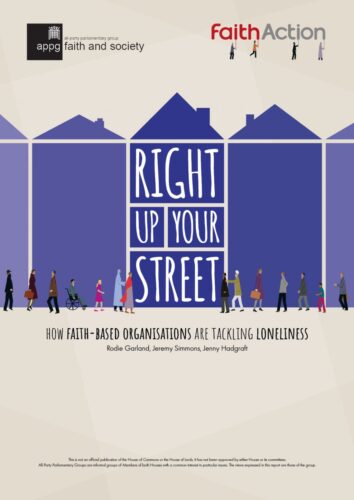
Right Up Your Street

How faith-based organisations are tackling loneliness. This report aims to explore the wide-ranging work of faith groups in response to the problem of loneliness. As a national network of faith-based organisations we are well aware, through contact with our members, that much is being done on the ground, but we wanted to probe further: To what degree is loneliness a priority for faith groups? What specifically is being done to address it? What themes and good practice can be identified that might be taken forward?

What Works in Prisons

This report identifies the following key findings about the provision of faith-based and non-faith organisations within the prison service. Faith-based organisations often provide specific support for targeted groups of prisoners. Non-faith organisations also play a key role in ensuring the needs of these groups are addressed Faith-based organisations offer spiritual and pastoral support to prisoners that is open to all. Faith-based organisations often provide a holistic approach to prisoner support. Both faith-based and non-faith organisations are keen to share best practice and use existing models of support.

Dementia Friendly Communities

Dementia is an umbrella term that describes the symptoms that occur when the brain is affected by certain diseases or conditions – for example, Alzheimer’s disease or a series of strokes. Symptoms may include memory loss and difficulties with thinking, problem-solving or language. There are 850,000 people living with dementia in the UK – a number expected to rise to over a million by 2025. Already an estimated 21 million people in England have a close friend or family member living with dementia. And, according to Alzheimer’s Research UK, dementia is the most feared health condition for people over the age of 55.

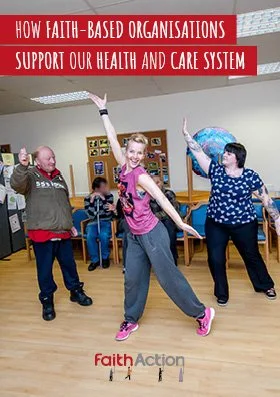
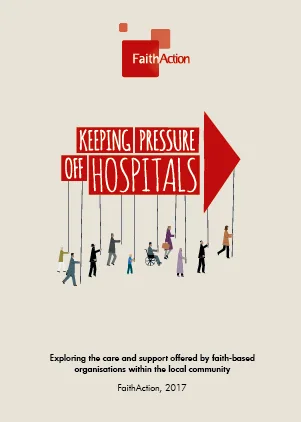
Keeping Pressure Off Hospitals

FaithAction was asked by Jon Rouse, then Director General in the Department of Health (now Chief Officer of the Greater Manchester Health and Social Care Partnership), to comment on the role that faith-based organisations (FBOs) currently play in providing out-of-hospital care in England – and what role they could play in the future. To help answer this question, FaithAction: Held three roundtable discussions, in Leeds, Greater Manchester and Hertfordshire. These gave FBOs the opportunity to highlight their work in this area, and also to meet with health commissioners and hear about local priorities for health and care. Used an online survey,

Working With Faith Groups to Promote Health and Wellbeing

There is a growing body of research which shows how faith groups can have a positive impact on both the health of their members and wider communities. In a few areas, councils are starting to develop a comprehensive approach to working with faith groups to tackle local health problems, and thereby making the best use of joint resources. In many others, councils and health partners have developed specific projects and services with faith-based organisations. However, across the board, there is much more that public health can do to tap into, and support, the assets that faith groups provide. Working with faith groups is part

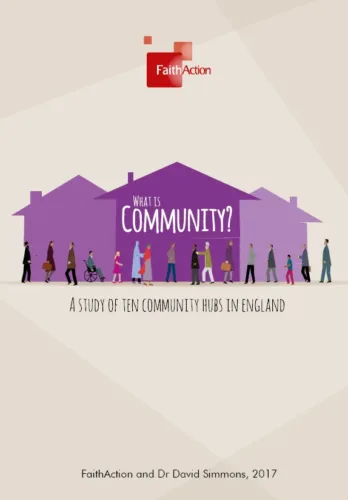
What is Community?

The purpose of this research was to highlight some of the exemplary work that is being carried out by faith groups across the country in creating community. It was also to consider the key ‘ingredients’ for building and sustaining effective community initiatives. Ten community initiatives were chosen, based on their location relative to areas of known deprivation, as well as their track record of not only delivering excellent services, but connecting people together in a way which enables them to achieve their potential. For want of a better term, we have called these ‘hubs’, although it should be noted that they do

What We Have to Say About English Language Learning

FaithAction has found that the current landscape of English language provision is fragmented and does not meet the range of existing needs. Government criteria are rigid and sometimes outdated, creating divides between learners by funding provision for some but not others, and setting up barriers that work against social integration. This report is a comment on that, learning that: English language provision needs to be flexible and capable of meeting individual needs, not one-size-fits-all. Two stages of language provision are needed to support integration for those who are ‘hard to reach’. Language provision needs to be more accessible from entry onwards.

Share this via