
As people of faith, serving other people in our community is a key part of our DNA. Where many of us may serve in formal projects, the long-term nature of faith groups and the potential for shifting roles encourages a relational approach, which allows for on-going coaching and mutual support sometimes over many years, as friendships form and people mix in a range of settings beyond where they first met. It is encouraging to remember that small acts of kindness and care, even in the short term often have a significant impact and can play a key role in altering the course of someone’s life.
We often don’t get to see the outcome of our efforts longer term, but here are a couple of stories from beneficiaries to remind us what the long-term outcomes can look like.
Jamal
Jamal was living in a hostel. “I didn’t have anything. I remember the kind people so well, who gave me warm clothes. They were new. The man just said they don’t fit me anymore. Just take it. I am so grateful. I didn’t have anything at the beginning just a thin jacket and a t‑shirt. It may have saved my life.”
Volunteers helped connect him with opportunities to improve his English, play football and volunteer. “It gave me a positive focus and helped improve my skills for work and my social network,” he said. “Everyone was so kind. Now I am a support worker helping people at risk of homelessness. I know what that feels like and want to treat people with the same compassion and dignity I was treated with by those volunteers.”
Mariam
When I first met Mariam in our Creative English Parent and Child class in 2009, she was quiet and careful in the way she moved. She often sat near the back of the room, her arms wrapped protectively around her child. Her eyes looked tired, not just from lack of sleep but from carrying a heavy load on her own.
She later told me how difficult life had been at that time. “We had nothing,” she said. “Just three plastic plates and three spoons. I cooked rice once a day for us. That was all we had.” It was clear that speaking about that period still touched something deep.
Work had been a struggle. “I did not know how anything worked here,” she explained. “I tried to find a job but did not know where to go. I was tricked online and lost money. Then I found work for one pound an hour. I had no one to look after my children. Everything felt so hard.”
Language was one of her biggest barriers. “Without English, you cannot be independent,” she said. “You cannot look after yourself or your children properly.”
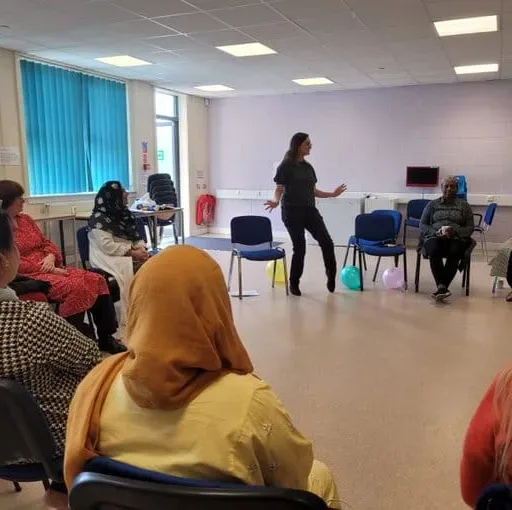
In our Creative English sessions, Mariam found a safe space to learn. She listened closely and repeated each phrase with great care. And she asked many questions, wanting to understand every detail. Talking to others in the group—many of whom had been through similar things—helped her more than any leaflet or website could.
During those early weeks, she made a friend who would become a constant support. “A good friend is like a therapist when life is tough,” she said. “She helped me stay strong.” Their friendship grew over time, and they still stay in touch today.
In time, Mariam found work as a receptionist. “I felt so proud answering the phone,” she told me. From there she became a healthcare assistant and later secured a job in a hospital. This meant she was able to buy a car, which made travelling around much easier. “I felt free for the first time,” she said.
She also worked hard to rebuild her credit score. “I never thought I could own a home,” she said. But, step by step, she made progress. The day she told me she had become a homeowner, she could hardly contain her joy. “I can paint the walls. I can put up pictures. It is really my home,” she said, smiling wide.
Looking back, she reflects on how far she has come. “If I saw myself now, at the start, I would be surprised,” she said. “I am a strong woman. I know I can deal with difficult things. My parents would be so proud.”
Chun Hei
Chun Hei came to the UK in 2023 due to what she described as “the rapid change of core values in Hong Kong, including the loss of basic human rights and free speech.” On arrival, she found herself very isolated. She did not know other Hong Kongers in the UK and, although she could read and write English fluently, she was unable to make herself understood in spoken English or to understand the informal speech of other people here. Then she joined Café Connect. This helped connect with not only Hong Kongers, but also native speakers. This was a really helpful way of finding out the things she needed, whilst also improving her familiarity with local expressions and regional accents. In time, Chun Hei started to volunteer. She became an informal community connector, helping other people get involved in the sessions and support. When she applied for work, the Creative English staff team were able to give her a reference. After a temporary contract, she was finally given a permanent job at a university. She said: “I know I still have things to learn, but I’m so grateful for the help I had when I couldn’t speak at all.”
Doris was one of the volunteers who hosted the Café Connect group Chun Hei attended. She said, “My anxiety was really bad when I started volunteering, but helping people really helped me too. I really enjoyed the group every week myself and feel really proud that I was a small part of Chun Hei’s journey and others like her. It’s a privilege.”