
Revisiting our suicide prevention work: still vital today

FaithAction

This week, we are highlighting our work on suicide prevention, a topic once again in the headlines as concerns are raised around autistic people, farmers, and emergency service personnel. Community-specific suicide prevention is essential because risk factors vary across groups. Tailored approaches make interventions more accessible, culturally relevant, and effective.

Recent reports demonstrate that:

  • Autistic people face higher suicide risk due to delayed diagnosis, stigma, and poor support. A Bournemouth University study calls for faster diagnosis and autism-informed mental health care.
  • The Police Federation reports over 100 officer deaths and 200 attempts from 2022–2025, linking many to misconduct investigations. Their plan urges mandatory reporting, limits on investigations, work-related recognition, coronial reforms, and full Police Covenant funding.
  • Farming charities say that UK farmers are facing a mental health crisis, with rising suicide rates and worsening wellbeing. Initiatives like Yellow Wellies’ Mind Your Head Week and youth-led initiatives provide training, raise awareness, and connect rural communities to vital support.

Our Talking Faith in Suicide Prevention toolkit, part of our work in the VCSE Health and Wellbeing Alliance, helps faith and community leaders and  frontline professionals to support people in faith communities. It covers why faith matters, eight key themes including compassion, community, and bereavement practices. The resource is a primer for faith-informed, culturally aware conversations about suicide prevention and postvention with adults and is intended for general guidance.

The toolkit was developed in collaboration with the Royal Borough of Kensington, Chelsea and Westminster City Council, as part of a wider project looking at suicide prevention and faith and belief.
Share this via

More from the blog

General

Change is here to stay!

It has not been an easy time for the faith and community sector, particular for those who are striving to serve their local communities, as is the case for our network members. The FaithAction team has always sought to be close to the ground, not afraid to get our hands dirty in delivering projects as well as advocating for our sector. This means that, like many faith-based organisations, we have to adjust to the delivery and financial situations that we face. This week we are announcing 2 significant changes: first, we say goodbye to Andrew Welsby who has served us all so well over the past 6 years. It is always bittersweet saying goodbye to colleagues, but Andrew has been a core part of so many of FaithAction’s projects and programmes for the long time that he’s been with us, and his depth of knowledge and diligence will be greatly missed! We wish him well as he begins a new chapter. For many of you, Andrew has been the first point of contact, so we know you will want to join us in expressing appreciation for all he has achieved these past 6 years. Secondly, we are also going to trial a change our regular e‑news. For…

Daniel Singleton
National Executive Director
2nd October, 2026
Faith in Partnership

Launching the Faith Covenant Guidebook

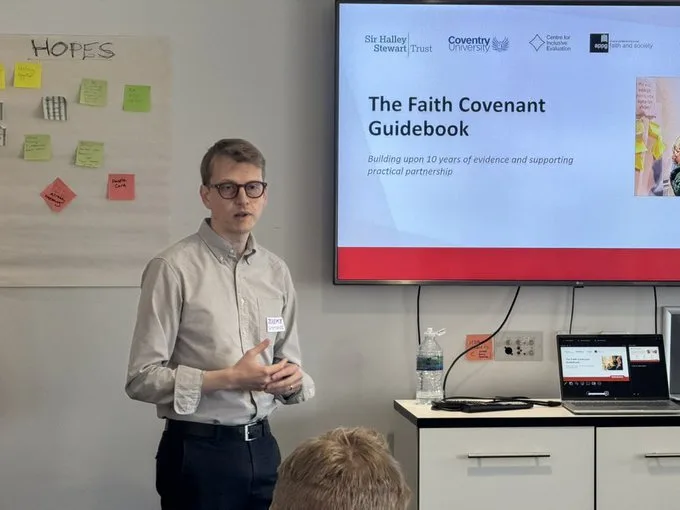
As we come to the end of Faith in Partnership Week 2026, we are delighted to announce the launch of the new Faith Covenant Guidebook! This is your first port of call for key information on the Faith Covenant initiative – what it is, why you may want to consider signing it (including what it’s achieved over the years) and how to set up for success. The Faith Covenant, if you’re not familiar, is a joint agreement between public-sector bodies and faith communities to strengthen trust and partnership working. Initially created to support relationships between faith groups and local councils, it’s expanded over the years to cover 33 partnership areas. The Guidebook is part of an ongoing project, let by FaithAction and the All-Party Parliamentary Group on Faith and Society, to better understand and strengthen Faith Covenants across the UK. Faith Covenants are also a key way for faith groups to work hand in hand with their local authorities, expressing the core principles behind Faith in Partnership Week. Whether you are looking to refresh or rejuvenate a prior Covenant agreement, or begin work from scratch, we hope the content here will aid on your journey. Where did the Guidebook come from? The Guidebook forms part…

FaithAction
11th September, 2026
Faith in Partnership

Five years of Faith in Partnership Week

Every September since 2022, FaithAction has used Faith in Partnership Week to put faith and statutory collaboration in front of parliamentarians, councils and the communities doing the work on the ground. With Faith in Partnership Week 2026 only days away, here’s a look back at what the first four years brought about. 2022: The first Faith in Partnership Week Keeping the Faith 2.0 Professor Chris Baker of Goldsmiths, University of London launched research tracking how the pandemic had reshaped partnerships between faith groups and local authorities. Paul Scully MP, then Minister for Faith, spoke at the launch, with a panel discussion chaired by Sir Stephen Timms MP. The Faith Covenant: What, Why, How A new primer set out the case studies, principles and first steps behind the Faith Covenant, published at a point when 24 local authorities had already signed up. First In, Last Out Commissioned by NHS England, this report, published as part of Faith in Partnership Week, captured the part faith groups played in the pandemic response and what that could mean for the new Integrated Care Systems. 2023: Building the evidence base A first for combined authorities The West Midlands Combined Authority became the first combined authority in the country to sign the…

FaithAction
4th September, 2026